




Teenagers today spend an average of seven or more hours a day on screens outside of school, according to Common Sense Media. That number surprises a lot of parents, yet most teens will tell you honestly that they are not always happy about it. The scrolling fills downtime, but it rarely leaves them feeling recharged. The right craft activities for teens do not just replace screen time; they give teens something screens cannot: a finished thing they made themselves.
This guide covers why hands-on creative hobbies for teens work better than rules or restrictions, which types of kits tend to stick, and four specific products worth looking at first.
Why Teens Reach for Screens When They're Bored

Before jumping into solutions, it helps to understand the actual problem. Screens are frictionless. A teenager can pick up a phone and be entertained within three seconds, no setup required. The challenge with promoting screen-free activities is not really about the content on the device; it is about convenience and instant reward.
Craft activities for teens work differently. They require a small amount of effort to begin, but once a teenager is ten minutes into a project, something shifts. The phone stops feeling urgent. A 2019 study published in the Journal of Positive Psychology found that people who spent time on creative tasks reported higher energy and more positive mood the following day. The key word is "after." The payoff from making something is felt when you look at the finished result, not during the process the way a social media feed delivers quick hits.
For parents, this means the goal is lowering the activation barrier. If the kit is already on the table, the instructions are visible, and there is nothing to assemble before starting, most teenagers will at least try it. From there, the activity sells itself.
What Makes a Good Craft Kit for Teenagers
Not every craft kit is appropriate for a 14- or 17-year-old. Kids-level projects get dismissed in five minutes. Adult kits with 400 steps and no guidance produce frustration instead of focus. The best options sit in a specific range.
A good craft kit for teenagers should:
- Have a clear finish line. Teens are far more likely to complete something when they can see how it ends.
- Require real attention without demanding expert skills. Too easy and they tune out. It was too difficult and they quit.
- Produce something worth keeping or displaying. Social proof matters at this age. If the finished product looks impressive enough to photograph or share, motivation stays high.
- Include everything in the box. Sending a teenager to find supplies mid-project is a fast way to lose the moment entirely.
Kits that hit all four of these points tend to become a genuine creative hobby for teens rather than a one-afternoon experiment.
Creative Hobbies for Teens That Actually Last
Most teens who develop lasting creative hobbies start with something visual and tactile. They want to see progress as they work, not just at the end. Three categories consistently produce repeat builders among the teen age group.
DIY Miniature House Kits

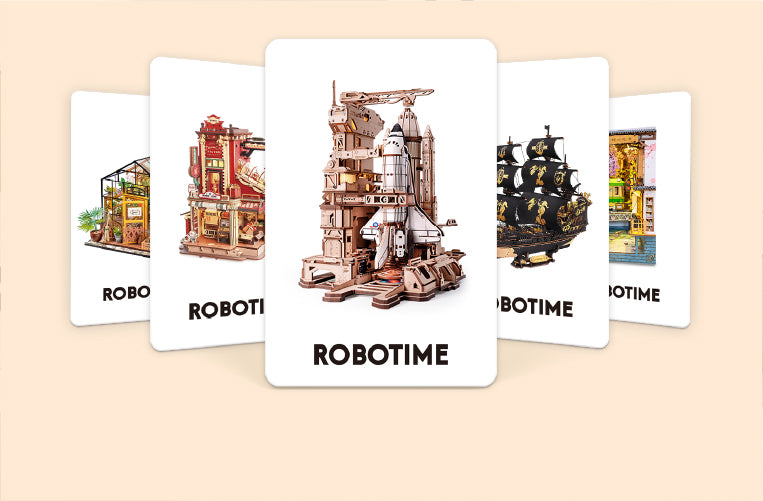
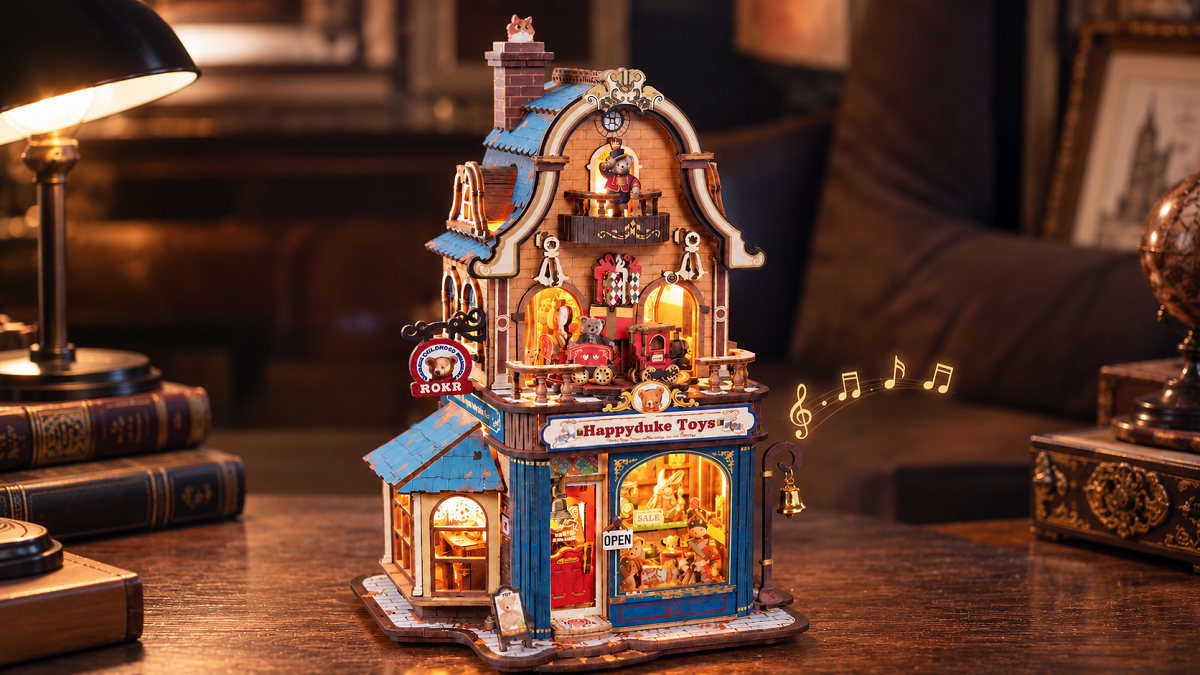
These kits involve assembling scaled-down rooms, shops, cafes, or studio spaces from laser-cut wooden pieces, tiny furniture, and LED lighting. The scale naturally forces slowness. You cannot rush a two-centimeter bookshelf into place, which is exactly what pulls teens away from the fast-paced world of swiping and scrolling. The finished product is a small, lit scene that looks like something out of a set designer's workshop.
3D Wooden Puzzles

Unlike flat jigsaw puzzles, 3D wooden puzzles from Robotime's ROKR line are built into functional models: music boxes, marble runs, mechanical clocks, and more. Teens who like how things work are especially drawn to these because the building process reveals the engineering behind the finished object. Watching gears connect and move as you add pieces is genuinely satisfying.
Book Nook Kits

Book nooks are shelf-insert dioramas, small scenes that tuck between books on a shelf. They appeal to teens who read, game, or are into fantasy and sci-fi aesthetics. The detail level is high enough to feel like a serious project without requiring any prior craft experience.
Four Craft Kits Worth Starting With
If you are buying for a teenager who has never tried a hands-on craft kit before, these four starting points are reliable. The trick is to begin with the smaller, lower-piece-count kits rather than the big detailed builds, so a first-timer finishes in an afternoon instead of stalling halfway through.
Rolife DIY Miniature House Kits
Rolife miniature house kits are among the most popular screen-free activities for teen girls and young adults in the 14- to 20-year-old range. For a true first build, point to the compact single-scene kits in Rolife's easy range, where the designs are simpler, the parts fewer, and the instructions clear. Each one comes with pre-cut wooden panels, little accessories, and illustrated step-by-step instructions, and the pieces snap together, so there is no fiddly LED wiring to wrestle with on the first try.
A good place to start is the Century Post Office (DS037) or The Muse Bookshop (DS040). The Post Office runs 54 pieces, assembles in about 1.5 hours, and carries a 1-star difficulty rating. The Bookshop is similar at 68 pieces and the same 1.5-hour, 1-star build. Themes across the wider lineup range from cozy flower shops to retro bookstores and post offices, so it is easy to match a kit to whatever the recipient is into. Once they have a build or two under their belt, larger, LED-lit kits make a great next step for anyone looking for more of a challenge.


ROKR 3D Wooden Puzzles
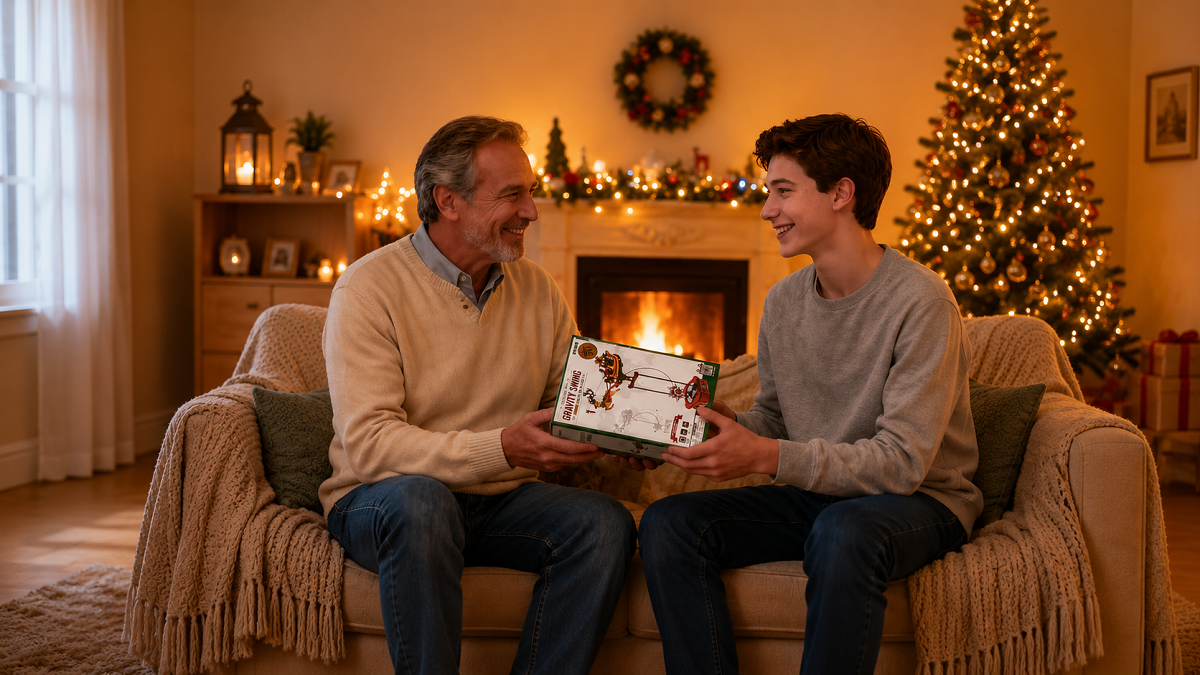
The ROKR line, also from Robotime, is built for teens who prefer mechanics over aesthetics. These kits assemble into working models with moving parts, but for a first mechanical build, the Gravity Swing (Pendulum Balance Toy) series is a gentler entry point than the bigger marble runs. Kits like the Sky Captain (MCD01) biplane and the Ocean Fisher (MCD02) fishing boat build a model that sways on its own once you give it a push. The motion is gravity-powered, with no batteries or electricity, and no glue is needed because the laser-cut birch pieces fit together cleanly.


That makes them a natural fit for the STEM-leaning 15- to 18-year-old crowd. Each kit runs around 160 wood and metal pieces and comes together in roughly 1.5 hours, and the swinging motion is a quiet lesson in balance and the trade-off between potential and kinetic energy. Robotime describes the build as approachable even for people new to the hobby. The series is gravity-powered and aimed at STEM learning, desk display, and gifting. Most ROKR kits are rated for ages 14 and up.
How to Make Screen-Free Activities Stick for Teenagers
Handing a teenager a craft kit is a start, but a few practical things will determine whether it stays on the shelf or becomes a genuine habit.
Set it up before they ask. Clear a surface, open the box, and lay out the first few pieces. The hardest part of any project is starting it. Removing that friction by doing the setup yourself dramatically increases the chance that a teen will sit down and engage.
Do not make it a rule. Banning screens to force craft time tends to backfire. Teenagers push back on mandates, especially around leisure. Introduce the kit as an option, not a replacement. If the activity is good enough, it competes on its own merits.
Build alongside them once. One shared session with a parent, sibling, or friend can change a teen's relationship with a hobby. It removes the awkwardness of figuring it out alone, and it creates a memory attached to the activity. That association does more than any instruction sheet.
Keep the partially finished project visible. An in-progress kit on a table is a visual invitation. A kit in a box in a closet is forgotten. Leave the build out between sessions so returning to it requires no decision at all.
Screen-Free Activities Beyond Craft Kits
Craft kits are one of the most accessible screen-free activities for teens, but they pair well with a broader environment that supports creative time. A few ideas that complement hands-on building:
- Drawing or sketching notebooks left open on a desk work the same way a visible craft kit does. No setup barrier, immediate start.
- Tabletop game nights introduce strategic thinking and face-to-face social interaction that screens rarely replicate.
- Outdoor photography with an inexpensive camera (not a phone) gives teens a reason to go outside and engage with their surroundings with genuine attention.
- Cooking one meal per week from scratch. The process mirrors craft building closely: steps, visible progress, a finished result you can share.
None of these require a parent to stay involved once the habit is established. The point is to offer a few appealing alternatives so that reaching for the phone is not the only comfortable default.
FAQs
What age group do Robotime craft kits work best for?
Most Rolife and ROKR kits are rated for ages 14 and up, which covers the full high school range and into early adulthood. Younger teens around 12 or 13 can manage beginner kits with some help on smaller pieces, but the complexity of intermediate kits is aimed squarely at the 14 to 18 range.
How long does a typical craft kit take to complete?
It depends on the kit size and how long a teenager sits in each session. Compact single-room miniature kits generally take three to five hours total. Larger builds, like multi-room houses or complex ROKR mechanical models, can take eight to fifteen hours spread across a week. That extended timeline is actually a benefit: it keeps the project active as a screen-free activity across multiple evenings.
Are craft kits good for teenagers who say they are not creative?
Yes. The structure of a kit removes the blank-canvas problem that puts off many teens who do not think of themselves as creative. The instructions tell you exactly what to do next, so the activity is more like guided problem-solving than open art. Many teens who resist drawing or freeform crafts find structured kit-building genuinely enjoyable.
Can craft kits work for teenage boys as well as girls?
Completely. The Rolife miniature house line is popular across genders, with themes that range from cafes and flower shops to retro diners and Japanese tea rooms. The ROKR mechanical puzzle line, with its marble runs, gear clocks, and locomotive models, draws particularly strongly from teens who enjoy building or engineering. Robotime has kits that cover a wide range of interests.
Will a teenager actually finish the kit or abandon it halfway?
That depends largely on which kit you choose and how you introduce it. Starting with a compact, beginner-friendly kit rather than the most impressive one on the page gives a teenager a win they can feel. A finished project is a much stronger motivator than a half-built one sitting in a corner. Most Robotime beginner kits are designed so that a first-time builder can complete them without frustration.
Final Thoughts
The best creative hobbies for teens are not the ones with the most pieces or the most impressive finished result. They are the ones that actually get picked up. A kit that sits at the right difficulty level, has a clear finish line, and produces something worth keeping will beat a screen for a teenager's attention more often than parents expect.
Robotime offers a wide range of craft kits designed to balance creativity, challenge, and accessibility. For teens looking to reduce screen time, products such as the Rolife Century Post Office , Rolife The Muse Bookshop, ROKR Sky Captain, and ROKR Ocean Fisher provide engaging alternatives that encourage creativity, focus, and a sense of accomplishment. These beginner-friendly kits offer a rewarding introduction to hands-on hobbies while helping teenagers create something meaningful they can proudly display long after the project is complete.


Priyanka Sharma
Priyanka is a content writer and SEO specialist with hands-on expertise in crafting blog posts, web copy, articles, product descriptions, newsletters, and ghostwritten content that ranks and resonates.
Robotime is a creative lifestyle company dedicated to designing and developing 3D puzzles, toys, and wooden handicrafts. Subscribe to learn more.
Enjoy Robotime building guides and creative inspiration?
Add Robotime as a Preferred Source on Google to see more of our latest stories in Search.
 Add Robotime to your Preferred Sources
Priyanka Sharma
Priyanka is a content writer and SEO specialist with hands-on expertise in crafting blog posts, web copy, articles, product descriptions, newsletters, and ghostwritten content that ranks and resonates.
Robotime is a creative lifestyle company dedicated to designing and developing 3D puzzles, toys, and wooden handicrafts. Subscribe to learn more.




Leave a comment
This site is protected by hCaptcha and the hCaptcha Privacy Policy and Terms of Service apply.