




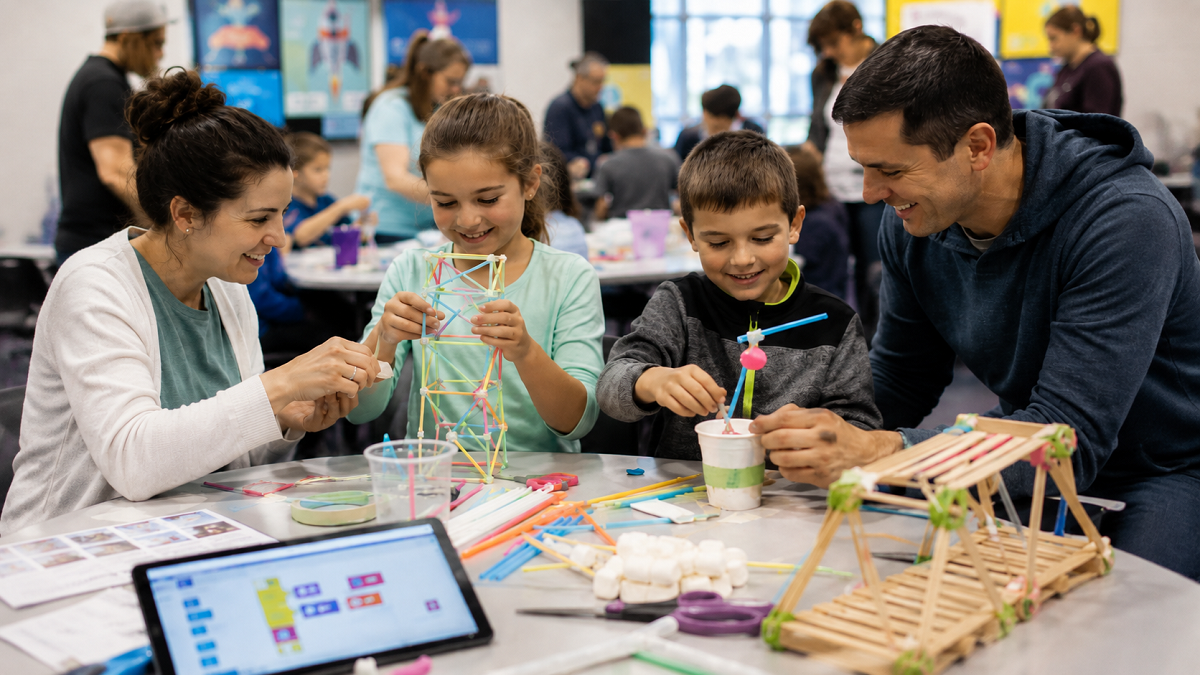
A STEM night is a wonderful opportunity to keep kids and their families engaged and excited about learning. Rather than sitting in the classroom, children can engage in problem solving, experimentation and construction with Science, Technology, Engineering and Maths.
Parents are also welcome to participate in activities, making learning an experience to share, resulting in curiosity and teamwork. School events, library programs and home family STEM nights are all ways to get everyone active and engaged with the right activities. Below are 10 activities to try at your next STEM Night and a few simple planning tips to help make your STEM Night a success.
What Is a STEM Night?
A STEM night is an interactive event where children and families learn about STEM concepts in an experiential way. All participants engage in experiments, engineering problems, and creative problems, rather than lectures and worksheets. STEM nights may be held at schools, libraries, museums, community centers, or homeschools; the goal is to create an opportunity for the family to be more engaged in learning.
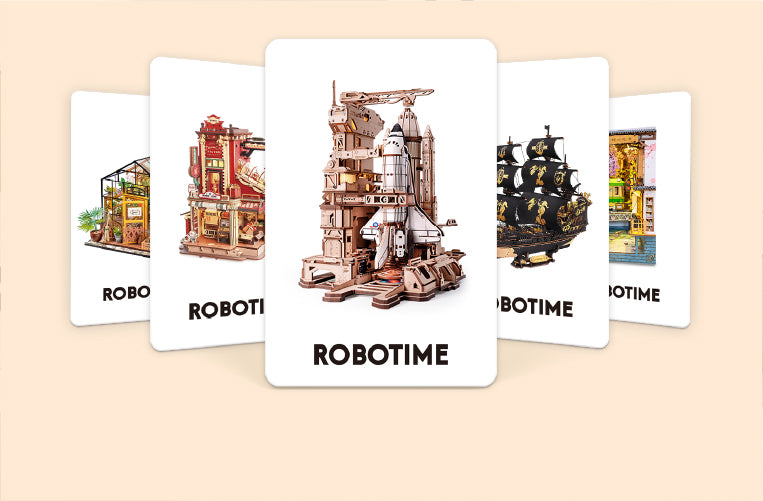
To encourage children to think critically, be creative, collaborative and problem solvers, and to make STEM a fun and learning topic. Families who want reusable activity inspiration can also explore Robotime's STEM Lab collection.
How to Plan a Successful STEM Night Event
Planning ahead makes a STEM evening fun, organized and easy for families to enjoy. Begin by choosing four to six activities that you think are age-appropriate and skill-appropriate for the children to do; in this way, all children can participate with confidence. Establish activity stations with materials and step-by-step instructions that are clearly labeled.
Have volunteers, teachers, or parents at each station to answer questions and to keep things going. Collect and try out all materials before the event, enough for each group to use.
Encourage families to collaborate, asking questions, trying out ideas, and discussing the results of each challenge after they've completed it. Lastly, give plenty of time for participants to visit each station without being rushed, and give them some small prizes or certificates to celebrate their efforts. The aim is to encourage curiosity, creativity and problem-solving, not competition.
10 Best STEM Night Activities for Kids
1. Construct the Tallest Tower

Families compete to create the tallest structure using only paper, tape and drinking straws to create a structure that will stand upright on its own. Kids soon discover that the tallest object does not necessarily make the strongest. They will need to consider balance, support and design as they collaborate to make their tower better before time expires!
2. Egg Drop Challenge

Egg drop is a traditional engineering activity that kids always love to do. Provide each team with paper, tape, straws, cotton balls and cardboard. Their challenge is to create a device that will protect the egg from falling from a certain height. Families can discuss which design worked best and which they would change after testing each one. This activity is an engineering, creativity and problem-solving activity.
3. Balloon Rocket Race

Tape a balloon to a string stretched across the room, and have children launch it by releasing the air inside. Families can experiment with the balloon size and the quantity of air to find out how they affect speed and distance. This is an easy activity for introducing concepts such as force, motion, and air pressure in a fun way.
4. Paper Airplane Competition

Challenge families to create the paper airplane that flies the farthest or the one that flies the highest. Children have the opportunity to try out various fold patterns and compare how well they perform after each flight. This activity is designed to teach them the basics of aerodynamics and motivate them to observe, be creative, and experiment.
5. Marshmallow and Toothpick Structures

Offer marshmallows and toothpicks for kids to create geometric shapes, bridges, or towers. They will learn which designs are stable and which are not as they put the pieces together. Great for introducing engineering principles and developing fine motor skills and teamwork.
6. DIY Weather Station

Encourage children to be young "meteorologists" by making something as simple as a wind vane, rain gauge or even a homemade thermometer with common items. When their weather station is finished, they can put it out in the open outdoors and make notes of the wind direction, the amount of rain, and the temperature on a daily basis.
7. Straw Bridge Challenge

The teams may use only drinking straws and tape to create a bridge strong enough to support the greatest amount of weight. Once built, add small objects to the bridge one at a time until it bends or collapses. Children are introduced to the concepts of structural design, load distribution, and how engineers test and improve buildings and bridges.
8. Coding Challenge Station

Introduce children to easy-to-learn tablet or laptop coding games. They can solve puzzles with simple drag-and-drop coding programs, arranging the commands in the correct order. They soon discover that coding is not just about using a computer but also involves logical thinking and step-by-step problem-solving.
9. Marble Run Engineering Challenge

Invite families to design, build, and test a marble run that keeps a marble moving for as long as possible or guides it successfully through different obstacles. As they experiment with ramps, curves, heights, and pathways, children learn about gravity, momentum, speed, motion, and mechanical engineering while improving their problem-solving skills.
For continued STEM learning beyond the event, reusable building kits such as the ROKR Marble Spaceport Marble Run 3D Wooden Puzzle by Robotime provide an excellent extension activity. After assembling the model, families can continue exploring engineering concepts by observing how steel marbles move through multiple tracks, switches, and both manual and electric drive systems.
10. Design a Parachute

Encourage kids to make and test their tiny parachutes out of paper, plastic bags, fabric, string, and other weights! After they are finished with their parachutes, they can let go one at a time from the same height and see which design would fall the slowest. Invite families to try a variety of different canopy shapes, sizes, and materials to determine the effect of the changes on the parachute's performance.
Following Are Suggestions for Making STEM Night More Interactive.
Limit activities to keep the children interested and allow time for them to visit each station. Have them think outside the box and pose questions, make predictions and try out various ideas as they work rather than just copying instructions. Be creative, as many STEM challenges can have more than one right answer. Most importantly, revel in curiosity and teamwork! Fostering a shared passion for STEM activities encourages children to have an enduring interest in STEM subjects when they enjoy experimenting with their families.
FAQs
At What Age Is STEM Night Best For?
STEM nights can be modified for kids of virtually any age. Just select activities they can do and offer additional support to younger players.
Are Supplies Needed for STEM Night Activities Expensive?
No. Little bits of paper, balloons, tape, cardboard, cups, straws, and recycled household items are used for many STEM challenges.
Does It Make Sense for Parents to Take Part in STEM Night Activities?
Yes. The purpose of STEM nights is to promote family learning. When children work together, they become more confident and it becomes more enjoyable.
What Is the Length of a STEM Night?
In most STEM nights, families are given 1-2 hours to participate in several activities without being rushed.

Laraib Shahzad
Laraib is a freelance writer who specializes in creating clear, engaging, and research-driven content.
Robotime is a creative lifestyle company dedicated to designing and developing 3D puzzles, toys, and wooden handicrafts. Subscribe to learn more.
Enjoy Robotime building guides and creative inspiration?
Add Robotime as a Preferred Source on Google to see more of our latest stories in Search.
 Add Robotime to your Preferred Sources
Laraib Shahzad
Laraib is a freelance writer who specializes in creating clear, engaging, and research-driven content.





Leave a comment
This site is protected by hCaptcha and the hCaptcha Privacy Policy and Terms of Service apply.