


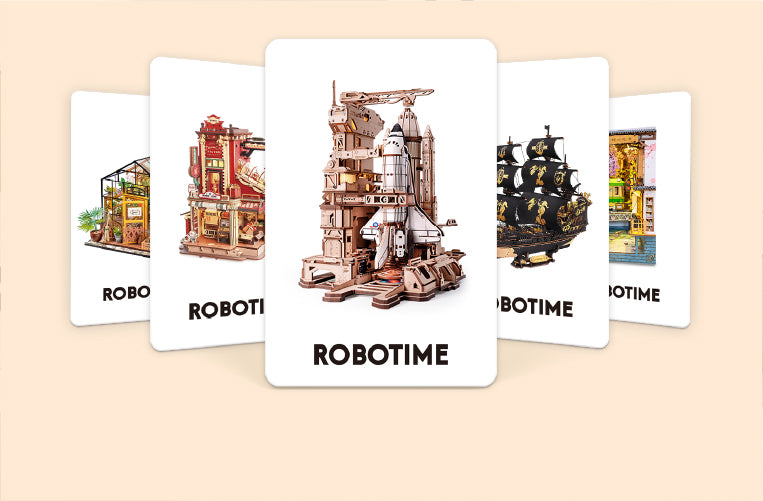



If you've already breezed through a few beginner puzzle kits and you're itching for something that actually fights back, you're in the right place. Advanced marble run kits aren't just bigger versions of the easy stuff; they're genuine engineering projects. Gears need to mesh correctly, tracks need careful alignment, and a part installed in the wrong direction can interrupt the marble's path.
That's exactly the appeal. Below, we'll break down what separates an "advanced" marble run from an easy weekend build, walk through ROKR's top picks for adults who want a real challenge, and cover what to do when (not if) you hit a snag mid-build.
What Makes a Marble Run Kit "Advanced"?
Not every marble run puzzle asks the same thing of you. A few things push a kit from "casual afternoon project" into "advanced" territory:
- Piece count. Advanced kits often run past 200+ laser-cut pieces, which means longer build times and a lot more room for error.
- Precision fit. Laser-cut parts and press-fit joints require careful alignment. A part installed in the wrong orientation can affect nearby tracks or mechanisms.
- Multi-stage mechanisms. Gears, cranks, diverters, lifts, and spirals; advanced builds layer several moving systems together, and each one has to work in sync with the others.
- Directional parts. Acrylic panels, bushings, and connector boards often have a "correct" orientation that isn't always obvious at a glance. Flip one, and the whole run jams.
- Sequential dependency. In a simple puzzle, a mistake stays contained. In an advanced marble run, an early assembly error can hide for dozens of steps before it shows up as a stuck ball three sections later.
In short: advanced kits reward patience, careful reading, and a willingness to backtrack. If that sounds like your kind of weekend, keep going.
Quick Comparison
Swipe left to view the full comparison.
| Marble run kit | Pieces | Assembly Time | Difficulty | Power Type | Linkable |
|---|---|---|---|---|---|
| Marble Travel London | 431 | 5 hours | ★★★★☆ | USB Type-C (5V-1A) | No |
| Marble Spaceport | 472 | 5.5 hours | ★★★★☆ | Manual or electric | Yes |
| Marble Night City | 294 | 7 hours | ★★★★☆ | Hand crank | Yes |
| Marble Parkour | 254 | 6 hours | ★★★★☆ | Hand crank | No |
| Marble Explorer | 260 | 5 hours | ★★★★☆ | Hand crank | No |
| Gear Ball Challenge | 653 | 5 hours | ★★★★☆ | Manual | No |
Best Robotime Advanced Marble Run Kits for Adults
The following picks are based on the advanced/hard marble run options available.
ROKR Marble Travel London Marble Run EGB01 - Best for Landmark-Themed Engineering
Marble Travel London combines a hand-cranked marble run with recognizable landmarks including the London Eye, Big Ben, and Tower Bridge. With 431 pieces and an official estimated assembly time of about five hours, it suits builders who want a substantial engineering project with a strong travel theme.

ROKR Marble Spaceport LGC01 - Best for Expandable Sci-Fi Builds
Spaceport pairs a detailed sci-fi diorama (complete with little astronaut figures) with a marble run engine underneath. What really sets it apart: it's one of the kits designed to link up with other compatible ROKR marble run sets using a link pack, so once you've mastered the base build, you can expand it into something bigger and weirder. If you like the idea of a build that keeps growing over time, this is your pick.

ROKR Marble Night City LGA01 - Best for Multi-Level Tracks and Industrial Styling
Marble Night City uses charcoal-gray printed wood, transparent acrylic guards, multi-level tracks, and a hand-cranked lifting system to create an industrial-style mechanical city. Its swing ball separator and branching tracks guide marbles through different routes, and the model can connect to Marble Spaceport with a compatible Link Pack. The official version is hand-cranked and does not include electric drive or LED lighting.

Further Reading: ROKR Marble Night City LGA01 Troubleshooting & FAQ
ROKR Marble Parkour LG501 - Best for Big Funnel Action
Marble Parkour centers the action on its signature big funnel track. Turn the hand crank to move the steel balls through the gear-driven lift, elevated rails, slopes, and twisting turns before they enter the funnel. It is a strong choice if the funnel sequence is the part of a marble run you most enjoy watching.

ROKR Marble Explorer LG503 - Best for Swingback-Rail Action
Marble Explorer is a tabletop marble run built around a swingback-rail wall, a crane-style lift, and a switch that directs marbles onto two paths. The "wall" in its name describes the swingback track structure within the model; the finished kit is not designed to be mounted on a room wall.

ROKR Gear Ball Challenge EGC01 - Best for Interactive Track Control
Gear Ball Challenge is an interactive marble run as well as a 3D wooden puzzle. Its 653-piece build combines an automated lift with switches, dials, a transparent ring track, a jump ramp, and other controllable elements, letting players change routes and race toward the finish.

Wooden Mechanical Kits vs. Modular Track Systems
Before you pick a kit, it helps to understand the two broad approaches to marble runs, because they scratch very different itches.
Wooden mechanical kits (like the ROKR builds above) are fixed-design puzzles. You follow a specific sequence, every piece has one correct home, and the challenge lives in precision assembly: getting gears meshed, diverters aligned, and lifts calibrated exactly right. Once built, the run is largely static; you crank the handle or flip the switch and watch your work pay off. The engineering challenge is front-loaded into the build itself.
Modular track systems, by contrast, are usually plastic or magnetic pieces you snap together in whatever configuration you like. There's no single "correct" build; the challenge is more creative and iterative; you build, test, tweak, and rebuild. They're great for experimentation, but they don't demand the same kind of careful, sequential precision.
If you want a finished, display-worthy piece that tests your patience and attention to detail, wooden mechanical kits win. If you'd rather tinker endlessly and redesign on the fly, modular systems are more your speed. Nothing wrong with owning both, honestly.
How to Choose an Advanced Marble Run Kit
A few practical things worth thinking through before you check out:
- Build time you can realistically commit: Advanced kits with 200+ pieces can take several sittings. Don't buy a multi-day build if you've only got one free evening a week.
- Display space: All six finished models require stable tabletop or shelf space. Compare their assembled dimensions before choosing; despite its name, Marble Explorer's swingback-rail wall is part of the tabletop model and is not a room-wall mounting system.
- Mechanism vs. theme: Some people build for the finished look, such as London landmarks, industrial styling, or a sci-fi spaceport; others build for the mechanical challenge itself, including gears, diverters, and timing. Figure out which one motivates you more, and let that guide your pick.
- Room to grow: If you like the idea of expanding your setup later, go with a linkable kit like Marble Spaceport or Marble Night City so you're not starting from scratch next time.
- Tools on hand: These kits primarily use laser-cut, press-fit or mortise-and-tenon construction. Follow the instructions for your specific model, and keep simple tools such as tweezers and a nail file nearby for careful adjustments.
What to Expect During an Advanced Marble Run Build
Go in with the right expectations and you'll enjoy the process a lot more.
First, expect to slow down. Advanced kits aren't built for speed; they're built for accuracy. Rushing a step now often means backtracking through five more steps later to fix it.
Second, expect directional parts to trip you up at least once. Acrylic panels, connector boards, and bushings can look similar from both sides, but their orientation may affect movement. Compare each part against the manual's reference images before pressing it firmly into place.
Third, expect multi-stage testing. Don't wait until the entire model is finished to test it. Build a section, test it by hand (slowly, without cranking), confirm the marble moves the way it should, then move on. Catching a jam early saves you from tearing apart four completed sections later.
And finally, expect a genuinely satisfying payoff. There's a specific kind of joy in watching a marble travel through forty steps of your own careful work without a single hitch. That's the whole point.
Common Marble Run Problems and How to Fix Them
Even careful builders hit snags. Here are the issues that come up most often across advanced ROKR marble run kits:
- Loose or wobbly parts after insertion: Check whether the piece is fully seated and facing the direction shown in the manual. Do not add adhesive unless the instructions for that specific model call for it, and keep tracks, gears, and axles unobstructed.
- Balls falling through instead of following the track: This almost always points to a missing or misaligned blocking piece somewhere upstream. Trace the ball's path backward from where it falls to find the gap.
- Reversed acrylic panels causing jam: Acrylic surfaces often have a printed or textured side that has to face a specific direction. If a panel looks "off" compared to the manual, flip it and test again before moving forward.
- A ball getting stuck at a curved or transitional track: Check for warped boards or nearby parts pressing against the track and restricting movement. Release any pressure first; if the board itself is visibly deformed and the ball still won't pass, that's a part-replacement situation, not a force-it-through situation.
- Balls only traveling in one direction through a diverter: Usually caused by a diverter piece that's either not pressed in fully or was installed backwards. Adjust the depth and orientation, then test slowly by hand before rebuilding around it.
- Bushings restricting movement inside a mechanism: If bushings are pressed too tightly, they can pinch the shaft and stop the ball cold. Loosen them just enough to sit flush, and test before sealing the section back up.
The golden rule across all of these: stop the moment something jams. Don't force it, and don't keep cranking. Take a photo, back up one step at a time, and fix the actual cause instead of pushing through it.
Final Thoughts
Advanced marble run kits aren't for everyone, and that's exactly what makes them worth doing. They ask for patience, close attention, and a willingness to redo a step you thought you'd already nailed. In return, you get a working mechanical sculpture you built with your own hands, something that keeps earning "wait, YOU made that?" reactions long after the build is complete. Whichever kit you pick from the list above, go in slow, test often, and enjoy the process as much as the finished build.
Related Reading: Marble Run Kits Guide and Advanced Mechanical Models: How to Choose Your Next Engineering Challenge.
FAQs
What's the hardest ROKR marble run kit to build?
Difficulty varies by piece count and mechanism complexity, but kits like Marble Night City and Marble Travel London tend to run longer and involve more interconnected mechanisms than others, which makes them feel more demanding overall.
Do advanced marble run kits require glue?
These kits primarily use laser-cut, press-fit or mortise-and-tenon construction, and Gear Ball Challenge is officially described as requiring no glue. Always follow the instructions for the specific model rather than adding adhesive near tracks, gears, or axles.
Can I connect multiple marble run kits together?
Some can. Marble Spaceport and Marble Night City both support expansion through a link pack, so you can combine builds into a larger, more complex run.
What tools do I need for an advanced build?
Most kits are designed to be built with what's in the box, but a small screwdriver, tweezers, a nail file, and a bit of wax or a candle stub (for smoother-moving parts) can make fine adjustments a lot easier.
What should I do if a part is missing or broken?
Don't force a substitute part into place. Contact support for a free replacement instead of pushing forward with a workaround that might affect the rest of the build.
How long does an advanced marble run kit take to build?
It depends on the kit, but most advanced builds take several hours spread across multiple sittings rather than a single afternoon. Rushing tends to cause more problems than it saves time.


Quincy Ihendeson
Quincy is an experienced writer, passionate about creating engaging blogs. She has been researching and crafting high-quality content since 2023. She currently contributes to Robotime, sharing her DIY journey and stories.
Robotime is a creative lifestyle company dedicated to designing and developing 3D puzzles, toys, and wooden handicrafts. Subscribe to learn more.
Enjoy Robotime building guides and creative inspiration?
Add Robotime as a Preferred Source on Google to see more of our latest stories in Search.
 Add Robotime to your Preferred Sources
Quincy Ihendeson
Quincy is an experienced writer, passionate about creating engaging blogs. She has been researching and crafting high-quality content since 2023. She currently contributes to Robotime, sharing her DIY journey and stories.
Robotime is a creative lifestyle company dedicated to designing and developing 3D puzzles, toys, and wooden handicrafts. Subscribe to learn more.


Leave a comment
This site is protected by hCaptcha and the hCaptcha Privacy Policy and Terms of Service apply.