




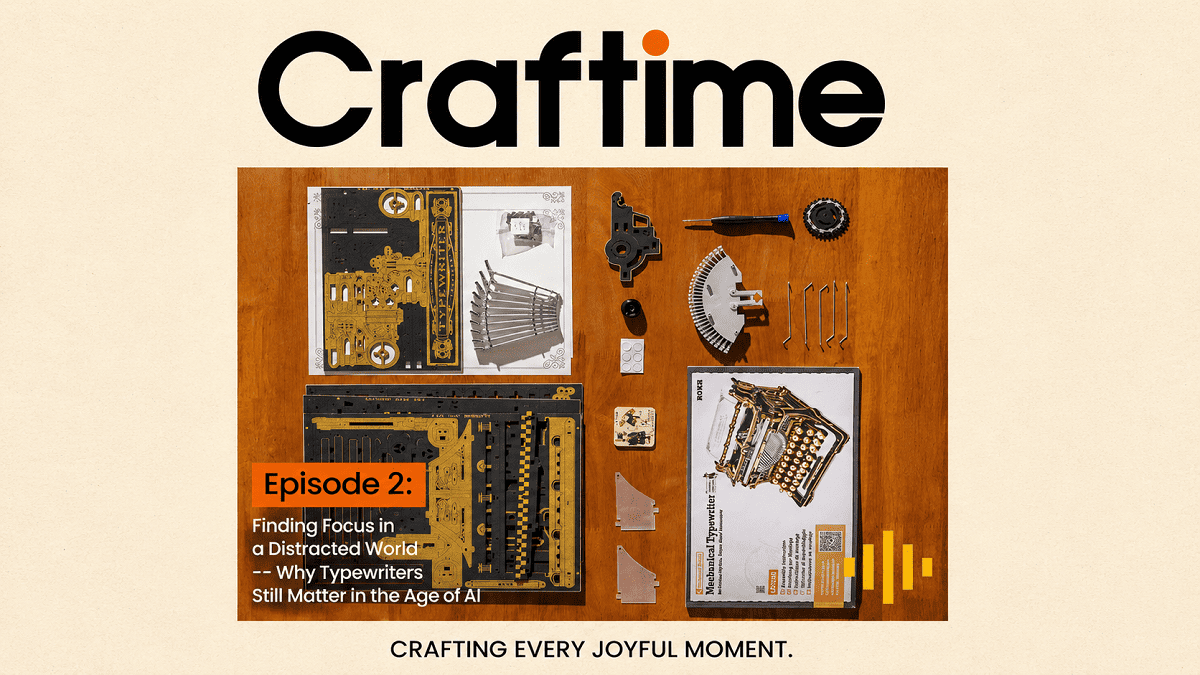
Craftime Episode 02
In a world shaped by screens, notifications, and AI-generated text, why are people still returning to typewriters?
In this episode of Craftime, Patrick sits down with Rodja Pavlik, a former journalist from Austria and the creator of the German typewriter blog Die Schreibmaschinisten. Together, they explore focus, distraction, craftsmanship, analogue hobbies, and why mechanical tools still feel meaningful in an increasingly digital world.
About This Episode
The sound of a typewriter feels strangely out of place today. Loud, mechanical, and slow, it seems to belong to another time. And yet, in a world filled with notifications, algorithms, digital workspaces, and AI-generated text, more people are rediscovering the quiet power of these old machines.
For Rodja Pavlik, typewriters are not just nostalgic objects. They are tools for focus. After more than 25 years working in media, he witnessed the shift from typewriters to computers, embraced digital technology during his journalism career, and later found himself returning to mechanical typewriters when the internet began to interrupt his writing flow.
In this conversation, Rodja shares how he first learned blind typing on an IBM Selectric, how computers transformed the workplace, and why he eventually bought a mechanical typewriter from a local flea market. The moment he heard the sound of the keys striking paper, he knew he had found the machine he was looking for.
The episode also explores the newly released ROKR mechanical typewriter 3D wooden puzzle kit, inspired by the classic Underwood No. 5. For Rodja, what makes this kit special is not simply its appearance, but the way it recreates the feeling, sound, and motion of a real typewriter.

At its heart, this episode is not only about typewriters. It is about how we create, how we focus, and why slower, more tangible experiences can still matter deeply in the age of AI.
What You’ll Hear in This Episode
- How Rodja learned typing on an IBM Selectric during the final years of the typewriter era.
- Why he embraced computers during his journalism career before returning to typewriters years later.
- How digital distractions, search engines, and constant editing interrupted his writing flow.
- Why a 20-euro flea market typewriter helped him rediscover focus.
- How his collection grew to around 60 typewriters.
- Why typewriters are not only nostalgic objects, but tools for writing, thinking, and slowing down.
- What made the ROKR wooden typewriter kit stand out to a longtime typewriter enthusiast.
Meet the Guest
Rodja Pavlik
Rodja Pavlik is a former journalist from Austria who spent more than 25 years working in the media industry. Based in Vienna, he now writes about typewriters, analogue writing culture, and mechanical craftsmanship through his German blog Die Schreibmaschinisten, which means “The Typewriters.”
Rodja first learned typing in school during the 1980s, when typewriters were already nearing the end of their mainstream life cycle. At the time, he did not realize he was witnessing a major technological shift. Years later, after decades of working with computers, he returned to typewriters as a way to write with more focus and less distraction.
Memorable Moments
1. Learning to type at the end of an era
Rodja learned the ten-finger typing system on an IBM Selectric before moving on to an electronic typewriter with a one-line memory. At the time, the ability to correct mistakes felt like the future.
Only later did he realize that he had experienced the final years of the typewriter as an everyday workplace tool.
2. Discovering the cost of digital distraction
After years of writing on computers, Rodja noticed that the internet was constantly pulling him away from his work. A simple fact check could turn into a search rabbit hole, and by the time he returned to the text, he had lost his place and his flow.
He also found that word processors made it too easy to correct, rearrange, and endlessly revise before the first draft had a chance to move forward.
3. Finding the right machine at a flea market
Rodja initially considered buying a modern digital writing device, but it was expensive and difficult to import. Instead, he found a mechanical typewriter at a local flea market for 20 euros.
As soon as he typed on it and heard the sound, he knew it was the machine he had been looking for.
4. A collection built one feature at a time
Rodja’s first typewriter was large, so he began looking for a smaller portable one. Then he wanted one with different ribbon colors. Then one with special spacing features. Then another with a different keyboard layout.
Little by little, his curiosity turned into a collection of around 60 typewriters, each with its own character and mechanical detail.
5. Seeing the ROKR typewriter come to life
When Rodja first saw photos of the ROKR wooden typewriter kit, he thought it looked detailed. But it was only after watching the video that he realized it was more than a display model.
The moving type bars, the sound, the imprint on paper, and the bell at the end of the line made it feel surprisingly close to the experience of a real typewriter.
Why This Story Matters
Typewriters are objectively less efficient than computers. Wooden puzzles are slower than digital entertainment. And yet, people are still drawn to them.
Rodja’s story suggests that this attraction is not simply about nostalgia. It is about the search for a more tangible, focused, and personal way to create. In a digital environment where everything can be edited, copied, deleted, and generated instantly, a mechanical tool asks for a different kind of attention.
That slower pace can feel meaningful because it gives us time with ourselves. As Rodja explains, efficiency is not everything. We do not go on holiday to be efficient. We go to relax.
The same can be true of crafting, writing, and building. Sometimes the value is not in doing something faster, but in being more present while doing it.
Frequently Asked Questions
What is Craftime Episode 02 about?
This episode explores why typewriters still matter in the age of screens, notifications, and AI. Patrick speaks with Rodja Pavlik about focus, analogue writing, mechanical tools, and the emotional connection people have with typewriters.
Who is Rodja Pavlik?
Rodja Pavlik is a former journalist from Austria who worked in media for more than 25 years. He runs the German typewriter blog Die Schreibmaschinisten, where he writes about typewriters and analogue writing culture.
Why did Rodja return to typewriters?
Rodja returned to typewriters because digital writing tools and the internet made it difficult for him to stay focused. A mechanical typewriter helped him write without constant distractions and reconnect with the physical act of creating text.
What makes typewriters meaningful today?
For many people, typewriters offer focus, tactility, and a slower rhythm of creation. They are not the most efficient tools, but they can make writing feel more intentional and personal.
What is the ROKR Typewriter 3D wooden puzzle kit inspired by?
The ROKR wooden typewriter kit is inspired by the classic Underwood No. 5 typewriter. It recreates elements of the typewriter experience through mechanical movement, sound, and hands-on assembly.
Is this episode only for typewriter collectors?
No. This episode is also for anyone interested in slow hobbies, analogue creativity, mechanical design, writing, crafting, or finding focus in a distracted digital world.


Robotime Creative Team
As Robotime's earliest audience and testers, they start from user needs and are dedicated to sharing stories and insights about the brand and its products.
Robotime is a creative lifestyle company dedicated to designing and developing 3D puzzles, toys, and wooden handicrafts. Subscribe to learn more.
Enjoy Robotime building guides and creative inspiration?
Add Robotime as a Preferred Source on Google to see more of our latest stories in Search.
 Add Robotime to your Preferred Sources
Robotime Creative Team
As Robotime's earliest audience and testers, they start from user needs and are dedicated to sharing stories and insights about the brand and its products.
Robotime is a creative lifestyle company dedicated to designing and developing 3D puzzles, toys, and wooden handicrafts. Subscribe to learn more.


Leave a comment
This site is protected by hCaptcha and the hCaptcha Privacy Policy and Terms of Service apply.