




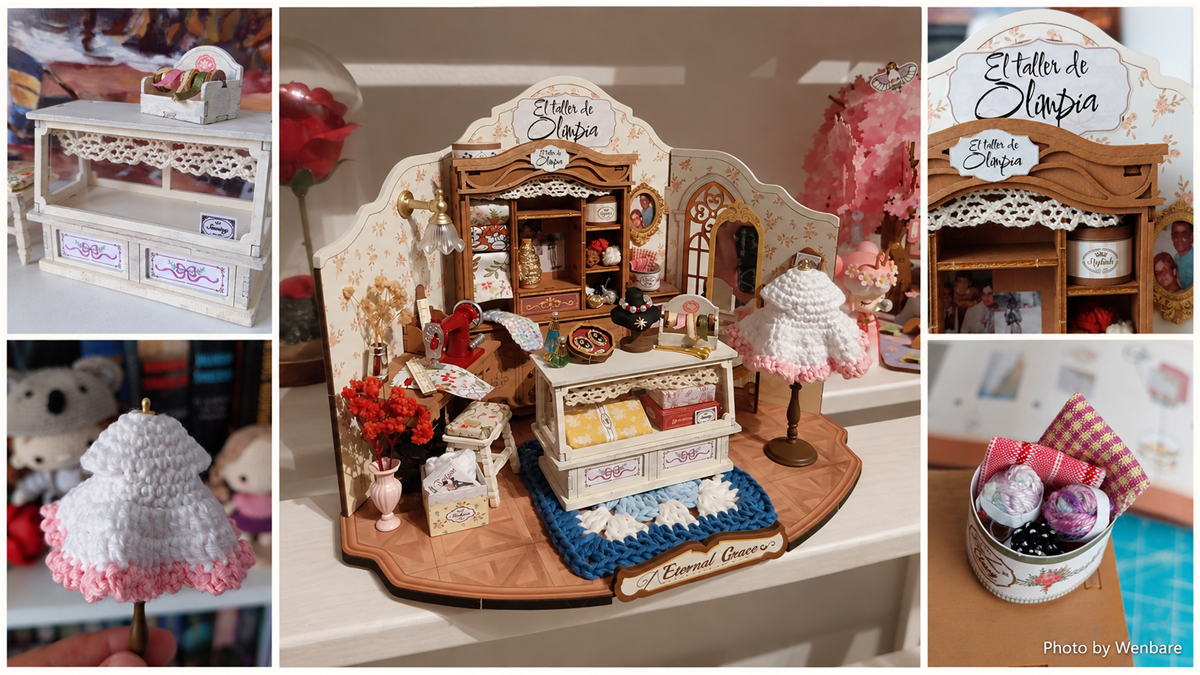
A tiny white dress stands at the right edge of the room, its crocheted stitches ending in a soft pink border. Across the workshop, yarn balls fill the shelves, family photographs sit among folded fabrics, and a new sign names the space El taller de Olimpia. The scene began as Rolife Elsa’s Tailoring, but every added detail has moved it closer to the life of one real woman.
Robotime Community maker Wenbare created the workshop for her grandmother, Olimpia, who spent much of her life sewing and crocheting. Working across several months, Wenbare aged furniture, changed textiles, rearranged the room and introduced objects connected to her grandparents’ story.
The result offers a useful idea for anyone planning a customized miniature: personalization does not have to mean replacing everything. A few materials, photographs and spatial choices can give an existing design an entirely different emotional center.
A gift shaped by a life of making
Wenbare’s idea started before the first piece was assembled. When she received the Rolife Elsa’s Tailoring DIY Miniature House (DG178), she immediately connected its vintage sewing-room setting with her grandmother. Olimpia had once worked as a seamstress and continued making large crochet blankets, so the kit already spoke a familiar visual language.

Her early plan was intimate rather than decorative: replace the kit’s portraits with family photographs, make the furniture look older and introduce textiles that recalled things Olimpia had made. Wenbare even considered using a piece from an unfinished pink blanket her grandmother had given her. The goal was not simply to build a tailor shop, but to make the room recognizable as hers.
Making the furniture feel lived-in
The transformation began with experimentation. Wenbare used acrylic paint and colored pencils to add worn edges, metallic touches and signs of age to the furniture. On the treadle sewing table, darker shading along the frame creates the impression of a piece that has been handled and used rather than freshly unpacked.


Distressed white paint on the counter and darker shading on the treadle base give two pieces different kinds of age. Photos by Wenbare.
That cautious approach is part of the project’s appeal. She did not begin with a rigid makeover plan. Instead, she tested finishes, kept elements that still felt right and allowed the room to develop one object at a time. For another builder, this is a practical reminder that customization can be incremental: try a finish on a less visible surface, compare it with the surrounding pieces, and decide what the story still needs.
Crochet becomes the visual language
The most distinctive handmade addition is the miniature dress. Wenbare crocheted a white garment with a pink scalloped border and fitted it to the mannequin, translating her grandmother’s craft into the scale of the room. The shape remains simple enough to read clearly, while the visible stitches make it unmistakably handmade.


A full process view and a closer portrait show how the white-and-pink crochet dress fits the miniature mannequin. Photos by Wenbare.
Crochet then spreads through the scene. A narrow trim runs beneath the cabinet top. A pale handmade piece rests near the sewing machine. A blue-and-white granny square sits beneath the counter like a rug. These additions do more than repeat a texture: together they make the room feel connected to a home where blankets and doilies were part of everyday life.
Turning photographs into part of the room
Family photographs give the workshop its emotional anchor. Wenbare resized and printed images of Olimpia and her late husband, including an old photograph of Olimpia wearing a dress made by her sister. Some appear inside the cabinet, while another sits in an ornate oval frame on the wall. They are small, but their placement among fabric and sewing supplies turns the display cabinet into something closer to a memory cabinet.


The wider progress view establishes the room, while the close-up reveals the personalized sign and family photographs. Photos by Wenbare.
Her method was accessible: measure the miniature frame, resize the photograph in a simple design program, print it and trim it to fit. She used a similar process for personalized paper boxes. The technical step is modest, yet it changes the viewer’s relationship with the scene because the faces belong to the family for whom the gift was made.
A room rearranged around her story
As the build progressed, Wenbare changed more than she initially expected. She swapped the positions of the table, mirror and dress, then filled the shelves with tiny yarn balls, folded fabric and a hidden crochet hook. The earrings and necklace from the original design stayed because they reminded her of Olimpia’s elegant style.


The sewing corner and cabinet show how rearranged furniture, textiles and keepsakes work together in the finished room. Photos by Wenbare.

The finished layout shows why moving objects matters. The crocheted dress receives its own space at the side, the sewing table creates an active work corner, and the central counter rests on the oversized granny square. Each zone now supports the same story instead of functioning as a separate decorative vignette.

The additions shown here—including the crochet work, photographs, yarn, fabrics and painted finishes—are personal modifications and are not included in the standard kit.
Practical customization ideas from the build
“If you want to customize a kit, don’t be afraid to move things around and test what looks best! Sometimes it’s worth breaking away from the original setup—it’s your space to play with.”
Wenbare’s Community posts also document techniques that can transfer to other miniature projects:
- Age furniture gradually. Build up acrylic paint and colored-pencil marks in light layers to suggest worn metal, chipped paint and years of use. Test the finish on an underside or another less visible area first.
- Measure before printing. Record the inside dimensions of each miniature frame, resize family photographs in a design program such as Canva, then print, trim and glue them in place.
- Turn yarn scraps into supplies. Roll short lengths into tiny balls and secure them with a very small amount of super glue or hot glue.
- Score paper folds for cleaner boxes. Use a ruler and a pointed tool to mark fold lines without piercing the paper, then assemble the pieces with a glue stick.
- Rearrange before fixing the layout. Test the table, mirror, dress and display pieces in several positions so the strongest details share the same sight line.
Where the workshop belongs
Months after finishing the build, Wenbare shared a glimpse of its life beyond the worktable. Olimpia had placed the workshop with other models her granddaughter had given her, in the dining-room area where she likes to show them to visitors. In the photograph, she smiles beside the cabinet while El taller de Olimpia stands among the collection.

That final setting completes the project. The miniature began with memories of sewing, crochet, a sister-made dress and a much-missed grandfather. It now sits in the home of the person whose life shaped every choice. What started as Elsa’s Tailoring has become a family object in its own right—small enough for a cabinet, but rich with details that belong to one family alone.
Explore the original Rolife Elsa’s Tailoring DIY Miniature House, or read Wenbare’s completed workshop story on Robotime Community.

Creative build and photography by Robotime Community member Wenbare. This project contains personal modifications and additional materials that are not included with the original Rolife Elsa’s Tailoring kit.
Related Reading: How BexBee Gave Rolife Elsa’s Tailoring a Dark Academia Makeover


Robotime Creative Team
As Robotime's earliest audience and testers, they start from user needs and are dedicated to sharing stories and insights about the brand and its products.
Robotime is a creative lifestyle company dedicated to designing and developing 3D puzzles, toys, and wooden handicrafts. Subscribe to learn more.
Enjoy Robotime building guides and creative inspiration?
Add Robotime as a Preferred Source on Google to see more of our latest stories in Search.
 Add Robotime to your Preferred Sources
Robotime Creative Team
As Robotime's earliest audience and testers, they start from user needs and are dedicated to sharing stories and insights about the brand and its products.
Robotime is a creative lifestyle company dedicated to designing and developing 3D puzzles, toys, and wooden handicrafts. Subscribe to learn more.


Leave a comment
This site is protected by hCaptcha and the hCaptcha Privacy Policy and Terms of Service apply.