




Marble runs have a funny way of hooking people. You set one marble loose at the top, and suddenly everyone in the room is watching it clatter, spin, and drop its way to the bottom. But before you buy one, there's a question worth settling: wooden or plastic?
Both have loyal fans. Both can turn an afternoon into an engineering lesson without anyone noticing they're learning. The real difference comes down to what you want out of the experience: a toy that gets tossed around daily, or a build that becomes something you're proud to keep on a shelf. Let's break it down in this article.
Wooden vs. Plastic Marble Runs at a Glance
Here's the short version, for anyone in a hurry.
Swipe left to view the full comparison.
| Feature | Wooden Marble Runs | Plastic Marble Runs |
|---|---|---|
| Durability | Sturdy, built to last for years | Lightweight, can crack or warp over time |
| Aesthetic | Natural, warm, display-worthy | Bright, colorful, playful |
| Build experience | Precision-engineered, satisfying to assemble | Quick to snap together |
| Price | Slightly higher upfront investment | Generally more budget-friendly |
| Best for | Hobbyists, older kids, adults, and display pieces | Younger kids and casual free play |
| Sustainability | Renewable material, eco-friendlier | Petroleum-based, less eco-friendly |
Not a bad cheat sheet if you're deciding right now. But there's more to the story, so let's get into it.
What Is a Wooden Marble Run?
A wooden marble run is exactly what it sounds like: a track system built from wood, where marbles or steel balls roll, spin, and drop through a series of connected paths. But calling it "just wood and marbles" undersells it a bit.

Wooden marble runs come in a few different flavors. Some are simple stacking systems, blocks or panels with grooves that you arrange on a wall or board, letting a child rearrange the path however they like. Others are precision-cut kits where every piece is laser-cut to slot together without glue, sometimes including working gears, ramps, funnels, hand cranks, or small motors that keep marbles moving in a loop. That range means wooden runs can be anything from an easygoing preschool toy to a genuine engineering puzzle.
Wood also just feels different in your hands. It's got weight, grain, and a certain warmth that plastic can't fake. That's a big reason wooden marble runs have become popular as home decor pieces and not just toys; a lot of people build them and then leave them out on a desk or shelf because they genuinely look good.
What Is a Plastic Marble Run?
Plastic marble runs are the ones most of us grew up with: brightly colored tubes, funnels, and connectors that snap or slot together in dozens of configurations. Think of the classic construction-toy style sets you'd find in any big-box toy aisle.

The appeal here is simplicity. Pieces are usually oversized, easy to grip, and forgiving if a kid jams them together the wrong way. There's no fine motor precision required, no risk of splintering, and cleanup is a breeze since most parts wipe clean.
Plastic sets also tend to be modular in a looser sense. You can mix pieces from different sets, build wild towering structures, and not worry too much about matching exact parts. It's less about precision and more about pure, unstructured fun.
Wooden vs. Plastic Marble Runs: Key Differences
Durability
Wooden marble runs are more durable. A well-made wooden marble run can survive years of assembly, disassembly, and the occasional accidental knock-off of a shelf. Plastic, on the other hand, gets brittle over time, especially with UV exposure or repeated stress on the connector joints. Cheap plastic snaps; quality wood bends and springs back.
Aesthetic and Feel
Wood brings texture and warmth. It looks intentional, like something you'd want on display rather than shoved back in a toy bin. Plastic leans into color and playfulness instead; it's louder, brighter, and honestly more fun for a five-year-old who just wants to watch marbles fly. Neither is "wrong" here. It's really about where the finished product is going to live.
Build Complexity and Skill Level
Plastic runs are built for speed. Snap a few pieces together, and you're playing within minutes. Wooden marble runs ask a bit more of you, and how much depends on the set.
Simple stacking or panel-based kits are still pretty quick to arrange. But the more intricate wooden kits have you following instructions, fitting interlocking parts, and sometimes assembling working gears or a hand-crank lift system. It takes longer, but that's kind of the point; the build itself becomes part of the entertainment.
Price and Value
Plastic sets are typically cheaper to produce and cheaper to buy. If you just need something to keep a toddler occupied, that lower price point makes sense. Wooden kits cost more upfront, but they're also built to last, which means you're not replacing them every year. Over time, the value gap narrows quite a bit.
Sustainability
Wood is a renewable resource. Most wooden marble run kits use sustainably sourced plywood, and they biodegrade eventually instead of sitting in a landfill for centuries. Plastic is petroleum-based, and while some brands use recycled materials, it's still the less eco-friendly option overall. If sustainability matters to your household, wood wins pretty easily here.
Which Type Is Better for Different Ages?
This is really the deciding factor for most families, so let's get specific.
- Toddlers and young kids (2–7 years old): Plastic wins here, hands down. Younger kids need big, chunky pieces that survive being chewed on, thrown, or mashed together the wrong way. Fine motor skills aren't developed enough yet for precision wood joinery, and honestly, that's fine. Let them play loud and messy.
- Older kids (8–13 years old): This is where wooden marble runs start to shine. Kids in this range have the patience and dexterity to follow assembly instructions, and there's real pride in finishing a build that actually works. It's a nice bridge between "toy" and "hobby."
- Teens and adults (14+): This is where the more advanced wooden marble run kits really shine. Some sets involve hundreds of pieces, working gear systems, and even lighting or motorized components. These aren't quick builds; they're weekend projects. And once finished, they're genuinely satisfying to display or gift.
If you've got a mixed-age household, don't stress too much about picking just one. Plenty of families keep both around: plastic for younger kids' free play and wood for the older ones (or the adults) who want a slower, more rewarding build.
Prefer a Build-and-Display Project? Explore ROKR Marble Run Kits
If the idea of building something with actual mechanical parts sounds more appealing than snapping plastic tubes together, Robotime ROKR's marble run collection is worth a look. These aren't your average marble run toys; they're intricate 3D wooden puzzles designed for teens and adults who want a genuine hands-on challenge.
A few standouts from the lineup:
ROKR Marble Spaceport Marble Run LGC01
If you want something that feels like a serious building project, ROKR Marble Spaceport LGC01 is a standout. It contains 472 pieces, takes approximately 5.5 hours to assemble, and has a four-star difficulty rating. The finished model measures about 12.3 × 9.8 × 9 inches.
The futuristic spaceport theme gives the finished model plenty of visual character, while six diversion mechanisms and five tracks create a more elaborate marble journey. It also supports both manual and electric drive modes, giving you another way to interact with the finished model.

Best for: Experienced builders, teens with adult guidance, and adults who want a substantial mechanical project.
ROKR Marble Night City LGA01
Prefer something with a darker, futuristic aesthetic? The ROKR Marble Night City LGA01 combines a mechanical marble track with a city-inspired design.
The model uses transparent components that let you see the marbles moving through the track, while features such as the swing ball separator create different paths and unpredictable movement. It's also compatible with ROKR's Marble Spaceport through a separate link pack, allowing builders to create a larger connected setup.

Best for: Sci-fi fans, collectors, and builders who want a display-worthy mechanical model.
ROKR Marble Travel • London EGB01
If futuristic cities aren't your thing, take a trip in another direction.
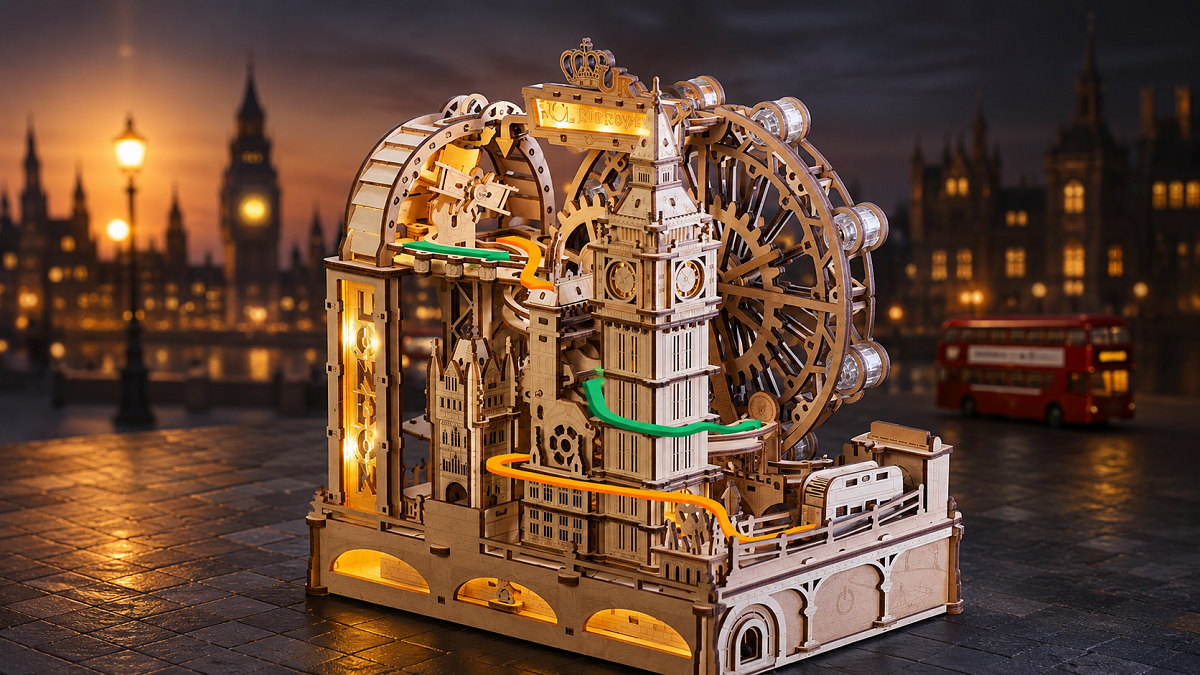
The ROKR Marble Travel • London EGB01 transforms familiar London landmarks into part of the marble-run experience. The design incorporates miniature versions of Big Ben, Tower Bridge, and the London Eye into the track.
This is also one of the more substantial projects in the collection. It has 431 pieces, takes around 5 hours to assemble, carries a four-star difficulty rating, and is listed for ages 14+. The result isn't simply a marble run. It's a miniature London scene with a functioning mechanical element running through it.

Best for: Travelers, architecture fans, adult hobbyists, and anyone who likes themed models.
ROKR The Last City Marble Run MR01S
For something more compact, consider ROKR The Last City MR01S.
This model has 130 pieces, an estimated 90-minute assembly time, and a three-star difficulty rating. Its assembled size is approximately 7 × 3 × 9 inches. The design combines a futuristic cityscape with illuminated mechanical elements. It also comes with a marble lift module, allowing the marble to cycle through the system rather than simply completing one downward journey.
The Last City can also be combined with The Future City and additional lift modules for larger configurations.

Best for: Beginners to mechanical wooden puzzles, teens, and adults who want a smaller project.
Final Thoughts
There's no universal winner here; it really depends on who's playing. Plastic marble runs are great for little hands that want quick, easy fun. Wooden marble runs are the better call for anyone who wants a real build experience, something durable, and a finished piece worth showing off. Know your builder, and the right choice pretty much picks itself.
FAQs
Are wooden marble runs harder to build than plastic ones?
Generally, yes, especially the more intricate kits. Wooden sets tend to involve more pieces and a more involved assembly process than plastic ones. That said, most come with clear step-by-step instructions, so it's manageable even for first-time builders; it just takes more patience than snapping plastic pieces together.
Which is safer for young children?
Plastic marble runs are usually the safer pick for toddlers and young kids, thanks to larger, rounder pieces designed with little hands in mind. Wooden marble runs, along with the small marbles or steel balls some kits use are better suited to older kids and adults who can handle smaller parts responsibly.
Do wooden marble runs need any special maintenance?
Not really. Keep them out of direct sunlight and away from excess moisture, and they'll hold up for years. Some kits recommend a bit of wax on moving parts for smoother motion, but that's about as involved as it gets.
Can wooden and plastic marble run pieces be mixed together?
Not typically. Wooden kits use precision-cut pieces designed to interlock with parts from the same system, so they won't fit with plastic connectors, and vice versa. It's best to stick with one type per build.
Are ROKR marble run kits suitable for beginners?
Yes. ROKR offers kits across a range of difficulty levels, from medium to hard, so there's an entry point for newer builders while still giving experienced hobbyists something challenging to sink their teeth into.
Related Reading: Marble Run Kits Guide; Best Marble Run Kits for Adults.


Quincy Ihendeson
Quincy is an experienced writer, passionate about creating engaging blogs. She has been researching and crafting high-quality content since 2023. She currently contributes to Robotime, sharing her DIY journey and stories.
Robotime is a creative lifestyle company dedicated to designing and developing 3D puzzles, toys, and wooden handicrafts. Subscribe to learn more.
Enjoy Robotime building guides and creative inspiration?
Add Robotime as a Preferred Source on Google to see more of our latest stories in Search.
 Add Robotime to your Preferred Sources
Quincy Ihendeson
Quincy is an experienced writer, passionate about creating engaging blogs. She has been researching and crafting high-quality content since 2023. She currently contributes to Robotime, sharing her DIY journey and stories.
Robotime is a creative lifestyle company dedicated to designing and developing 3D puzzles, toys, and wooden handicrafts. Subscribe to learn more.



Leave a comment
This site is protected by hCaptcha and the hCaptcha Privacy Policy and Terms of Service apply.